
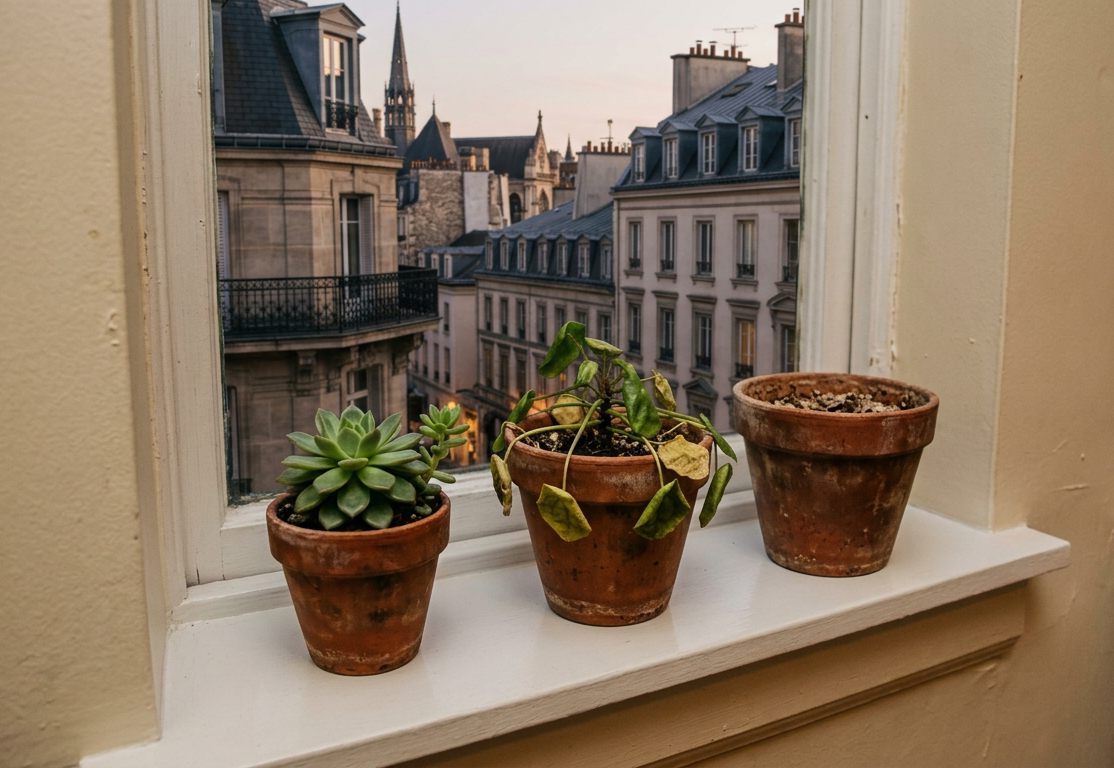
Most of the plants that come into our home end up dying.
I want to say that plainly, because I think a lot of people are quietly carrying the same thing and assuming it’s a personal defect. It isn’t. Let me explain what’s actually going on.
Why they die, honestly.
Yes, I forget sometimes. That’s real and I’m not going to pretend otherwise.
Forgetting is only part of it. The bigger part is the space itself. The light doesn’t reach far enough into the rooms. Then there’s water, too much or too little, and it’s genuinely hard to know which until the plant is already telling you it’s too late.
Then, in my case…there are the kids. To a small child, a plant is not a living thing that needs care. It’s a toy. Soil is something to dig in. Leaves are something to pull. That’s not bad behavior, that’s just what a young child does with anything within reach. It’s also one more thing standing between a plant and a long life in a home like ours.
Put all of that together and you get the honest picture. In a small apartment with poor light and young children, keeping a plant alive is genuinely difficult. Not impossible. Difficult, in a way that has very little to do with how much you care.
Why we keep buying them anyway.
Knowing all of that, I still want plants. I want more greenery inside. I want the place to feel alive and a little more mature, less bare.
The clearest version of this feeling is when I walk into someone else’s home that’s full of well-kept indoor plants. There’s a peace there that I notice immediately. The room feels calmer. It feels tended. It feels like life is happening in that space and someone is taking care of it.
That’s what we’re really buying when we carry a plant home. Not a decoration. A small piece of the outside, and the hope that our home can feel like that too.
My architect point of view and what I have noticed.
There’s something worth sitting with here.
Plants struggle in small dark apartments for the same reasons we do. Not enough light. Not enough space. Bad air quality. Conditions that a living thing has to endure rather than thrive in.
The plant is just the visible version of it. It shows you, in a few weeks, what the home is quietly doing to everything living inside it, including you. When a plant dies on a windowsill that gets almost no sun, that’s not a verdict on your green thumb. It’s information about the room.
I’ve written before about light and about what its absence does to us. The plant on the shelf is the same story, told faster.

The empty pot.
When one dies, I feel guilt and frustration.
Not exactly failure. Something more specific than that. You’re left standing there with an empty pot, and you know that thing could have had a long life. Years of it… and it didn’t, because of something you did or didn’t do, or because of a room you couldn’t change.
An empty pot is a strange object. It’s not neutral. It’s a small reminder of a hope that didn’t work out, sitting on your shelf until you decide what to do with it.
I don’t think that feeling needs to be talked out of. It’s just true, and most people who’ve killed a few plants know exactly what I mean.
What actually helps.
I’m not going to tell you to try harder. That’s not the problem.
Choose plants for the home you actually have. Not the bright, airy one in the photograph. If your rooms are dark, get the plants that tolerate dark. There are plenty that will survive conditions that kill most others. Working with your real light is the single biggest thing.
(This is what we did and it has been alive for the last 6 months…wohoooo)
Start with one. One plant you manage to keep alive is worth more than a shelf of struggling ones. The shelf just multiplies the guilt.
Put it where it has a chance. The best light you have, and out of reach of small hands. Both of those matter more than which plant it is.
Learn that one plant’s rhythm. Not plants in general. Just the one. How often it actually needs water, what it looks like when it’s unhappy. It becomes a habit instead of a guessing game.
When one dies, let it teach you something about the room rather than about yourself. That corner kills things. Good to know. That’s not failure, that’s information you didn’t have before.
One thing to try this week.
Move one struggling plant to the best light in your home. Just move it. Don’t buy anything.
Or, if you have nothing living in your home right now, get one plant that suits your actual conditions and put it somewhere you’ll see it every day.
One plant. The right spot. That’s the whole task.
What’s the plant you keep trying with, or the one you finally gave up on? And do you know now why it never worked?
Leave a comment or reply to the newsletter. I read every single one.
Leave a Reply